
I originally wrote this encyclopedia entry on medieval peasant rebellions for Bloomsbury Medieval Studies’s Encyclopedia of the Global Middle Ages in 2019 (PDF attached). As I’m now within my rights to share it freely, I do so here.[1] The illustrations were not part of the original entry but have been added for the benefit of website readers.

Introduction
Rebellions occurred frequently throughout the global medieval world. They occurred because of a variety of issues at a local and national level, although all of them fall broadly into the several categories: resistance to taxation; grievances against a corrupt government, both parochial and national; dissatisfaction with the feudal system; and opposition to foreign oppressors.
These categories are not mutually exclusive. During Wat Tyler’s Rebellion in England in 1381, for example, the rioters aimed for the abolition of both the poll tax and serfdom, while at a meeting between Wat Tyler and Richard II at Rotherhithe, Tyler demanded that the king’s advisers should be put to death because they were corrupt. The demands of Tyler’s rebels, therefore, fit into three of those categories outlined above.

An example of local issues causing commoners to unite en masse against a manorial lord can be found in the actions of serfs at thirteenth-century Itteville, who took back goods that had been seized from them to pay tallage. The rebellions of Edgar the Atheling in 1069 and that of Hereward the Wake against William the Conqueror in England reveal that people also rose in resistance to foreign oppression.
The romantic interpretation of medieval rebellions often highlights the role of the peasant classes in challenging the status quo and securing concessions from local and central government. Wat Tyler’s Rebellion was, for a large part of the nineteenth century, known primarily as a peasants’ revolt.

Yet all classes were known to participate in rebellions, and they certainly did so in Tyler’s rebellion. Some rebellions against kingly authority were led by lords, others by priests, while others were “pure” peasant movements. Any scholar who wishes to approach the study of rebellions and unrest in the “global” medieval period must take account of these factors in their analysis, and this article provides an overview of several revolts
Perspective:
Any summary that seeks to give an overview of rebellions in the medieval world must, of course, first define where the “medieval” period happened and, in those regions which experienced the Middle Ages, determining when it happened. Within the field of global history, the idea that there was anything like global Middle Ages is met with some resistance.
In Western Europe, the “classic” view of the medieval period holds that—with some exceptions—the era began as the power of the Western Roman Empire fell in 476, and to have lasted until ca. 1500. Even within this classic schema problems are encountered at a national level. The Roman presence in Britain, for example, ended earlier than 476 when the legions withdrew in 410. The experience of the decline of the Roman Empire and the “emergence” of the medieval era in continental Italy was much different to that of Britain. Even after Romulus Augustulus was deposed by Odoacer in 476, for example, Italy retained diplomatic, religious, and social ties with the still-flourishing Eastern Roman, or Byzantine Empire, centred at Constantinople.

To describe the earlier part of the Middle Ages, German historians in the early twentieth century opted for “Late Antiquity.” This term implies that there was less of an abrupt transition in Western European politics, economics, social life, and culture than the changes implied by “Antiquity” and “medieval.”
However, “Late Antiquity”—which apparently ended in 700—is inadequate to describe events, places, and people particularly in Britain and France; by 500 and 600 Britain might be said to be thoroughly “medieval.” Existing definitions of a global medieval period are less than adequate. Catherine Holmes and Naomi Standen’s definition of a global Middle Ages
argues[s] that however great the methodological, terminological and political difficulties associated with an approach termed the “Global Middle Ages,” the plentiful evidence for behaviour and interaction on a global scale in the millennium before 1500 deserves sustained and precise analysis … They were a period of dynamic change and experiment when no single part of the world achieved hegemonic status.
Every period of history is “a period of dynamic change and experiment” and to use such a definition takes no account of the social, cultural, and intellectual context within individual states—no single power can be said to have achieved hegemonic great power status until Britain in the nineteenth century and to imply, even accidentally, that the entire world before the rise of the British Empire was “medieval” is quite wrong.
Yet in a Western European context “medieval” also carries with it specifically religious connotations: Western Europe was Christian and, until the Reformation, most people looked to the pope in Rome as the authority on religious matters. The church also responded to challenges to its authority, a notable example being the suppression of the Cathars during the Albigensian Crusade (1209–29).
Sometimes the actions of the church could precipitate a rebellion, much like what occurred in the reign of King John of England when the country was placed under a papal interdict. This, combined with other factors, caused the barons to rebel and gain concessions from King John in the form of the Magna Carta in 1215.
The people of Europe and the Middle East, of course, were not only Christians. Two other religions shaped the medieval world: Judaism and Islam. Jews in what is now Palestine mounted revolts against the Byzantine Empire between 602 and 628, intending to create a self-governing polity for themselves.
In Iran, Ibn Fuladh led a revolt in 1016 against the ruling Bayud Dynasty intending to secure autonomy for his fife. The latter revolt certainly occurred during the time that Europe was said to be in the medieval period, although the non-Christian, non-European location of the revolt might make some scholars question whether it can properly be called a “medieval.”
Even if scholars could come to a consensus on when the medieval period occurred, and what it should be called, one question then remains to be asked: if “medieval” describes a period of time, where did this medieval period occur?

The details given above fit events in Western Europe and the Middle East, but “medieval” as a concept can be an awkward fit for other regions of the world. This is notably the case with the Caribbean and South America, whose histories have traditionally been divided into “pre-Columbian” and “post-Columbian.” As the Columbian exchange occurred at a moment when the “medieval” period was deemed to be ending in Europe—and if the Middle Ages are defined by European events such as the fall of Rome—it makes little sense to speak of a medieval South America. The same pitfalls present themselves to scholars if they wish to research the history of “medieval” Australia or sub-Saharan Africa.
If “medieval” refers to specific types of economic and social relations which could be called “feudal,” then with some justification the term can be applied to China, Japan, as well as North Africa. Yet all of these regions have different beginning and endpoints for their “middle” ages. In some cases, those regions do not subscribe to a Eurocentric calendar. This is certainly the case with China, a country which did not, for much of its history, recognize the Western B.C.E. and C.E. dating systems. China’s medieval era, in fact, is said to have begun in 220—much earlier than Western Europe—and ended in 1368 when the Yuan Dynasty fell due to armed uprisings.
Japan’s Middle Ages are generally accepted to have lasted until the seventeenth century. Thus in any survey of rebellions in the global medieval world, the huge peasant uprising called the Jōkyō Rebellion (1686)—two years before England’s “early modern” Glorious Revolution—must also be considered. Frequent rebellion of the chieftains in the “medieval” African Kingdom of Benin occurred throughout the sixteenth century—the same time that Europe is said to have entered the Renaissance.

The hesitancy with which scholars apply “medieval” to non-European places and peoples accounts for the fact that, in the history of medieval rebellions, those which occurred in Europe have received greater scholarly scrutiny from medieval historians. England and France are famous for the rebellions that occurred during the medieval period.
The rebellions of Hereward the Wake, Eustace the Monk, and the suppression of northern rebels in the wake of the conquest by William of Normandy in 1066 are well-told tales. In Italy, there was the Sicilian Vespers which culminated in the overthrow of the French king, Charles I. The Jacquerie, a peasants’ revolt that occurred in France in May–June 1358, and the so-called Peasants’ Revolt of 1381 in England, have likewise received a significant scholarly attention.
Questions of time, place, and culture must therefore inform scholars’ understanding of rebellions in a global context. In academic scholarship, a truly global perspective on these events was ignored from the late nineteenth to the mid-twentieth century. The historians’ discipline having been professionalized at the end of the nineteenth century, academics’ research on rebellions was focused on the level of the nation-state.

A pan-European perspective on the history of insurrections and rebellions was present in wider culture, however, particularly among Victorian amateur historians and activists who were connected with the nascent socialist and communist movements. Being internationalists, they sought to tell stories of continent-wide histories of class struggle. In a series of articles titled “Socialism from the Root Up”—later expanded and published as Socialism, Its Growth and Outcome (1893)—the famous William Morris, along with Ernest Belfort Bax, also presented a pan-European perspective on these rebellions. Medieval rebellions, they argued, were small-scale class struggles between the proletariat and the ruling class. These authors argued it was in this context that stories of Robin Hood emerged in the fifteenth century which embodied this “spirit of resistance” against the medieval ruling classes. In (their) theory, such rebellions would grow in number throughout successive centuries and eventually bring about socialism.

The neo-Marxist historians of the mid-twentieth century were the heirs of older radicals and socialists who sought to present an internationalist history of class struggle. In the field of medieval studies, a key text was Rodney Hilton’s Bond Men Made Free: Medieval Peasant Movements and the English Rising of 1381 (1973). Hilton took a European-wide perspective on revolts that occurred in England and on the Continent between the sixth and sixteenth centuries.
The overview below expands on the early internationalist, or pan-European, socialist interpretation of medieval revolts by expanding the “global” parameters even further. Although questions have rightly been raised over the application of “medieval” to non-European cultures, the summaries that are given below—and in the accompanying case studies—reveal the importance of such revolts in world history during the medieval period.
Scope:
Rebellion and unrest in the global medieval world stemmed from a variety of causes and their participants were drawn from a diverse range of social classes. This section presents a summary of selected revolts from around the medieval world. They are presented in chronological order but categorized according to the typology outlined above: resistance to taxation; grievances against corrupt local and national government; dissatisfaction with the feudal system; and opposition to foreign oppressors.
Peasants took a prominent role in several revolts during the medieval era but it should be noted that not every instance of peasant dissatisfaction and unrest culminated in large-scale violence, the likes of which were seen in 1381. Unrest often occurred because of highly localized grievances on the part of the peasants. In such instances, the protestors may have taken direct action but the matter would be settled swiftly.
Unrest-but-not-rebellion
Marc Bloch in Melanges Historiques (1963) and Rodney Hilton highlighted some instances of unrest-but-not-rebellion. Between 1240 and 1263 the peasants of the Bagneux Estate successfully won enfranchisement—a degree of self-government—and resisted encroachments on what they perceived to be their rights. Their aim was the abolition of tallage—an arbitrary tax, which could be quite heavy and which could be levied at will by the manorial lord. The lord was within his rights to levy the tax but it was generally a good idea for a lord to take cognisance of local public opinion before extracting further taxes from peasants.

The Bagneux peasants had no issue with paying their regular dues to the lord in the form of services and rent, but they objected to the spontaneous manner in which tallage was levied and preferred to pay a fixed annual payment. After some negotiations between the peasants and the lord a fixed annual payment was agreed upon going forward. Other villages took direct action: when, in 1268, agents took goods from the peasants of Itteville to pay the tallage the whole village banded together and took their goods back by force. The events at Bagneux, Itteville, and other places can be characterized as “unrest,” but they never broke out into open rebellion.
The Red Turban Rebellion
The fourteenth century was marked by several rebellions. The aforementioned Jacquerie in France and Wat Tyler’s rebellion in England are two famous examples. Looking east there was the Red Turban Rebellion in China: this was a large scale peasant revolt in which the people threw off the weight of their foreign oppressors—at least that is the interpretation of the revolt in the official 322 volume Chinese chronicle The History of Ming, as well as the other “official” Chinese history chronicle The History of Yuan.
Yuan China—a successor state of the Mongol Empire—had ruled China since 1271. By the 1340s, however, Yuan China was in a parlous state: the Black Death had ravaged the land, resulting in the deaths of two out of every three Chinese people; its rulers frequently, and arbitrarily, raised new taxes for the maintenance of the state; and a series of natural disasters including floods and earthquakes added to the people’s woes. A leader named Guo Zixing arose and founded the Red Turban Army—so-called because of the colour of their turbans—and sought to overthrow their “barbarian” Mongol rulers.


Although the term “guerrilla warfare” was not coined until the Peninsula War (1807–1814), the tactics of the Red Turban Rebels were similar. The rebels did not mount just one revolt but a series of revolts while others turned to highway robbery and harassed tax collectors on their travels. The rebels briefly managed to occupy the cities of Pyongyang in 1359 and Kaesong in the following year. The extent to which these rebels were, in their early years at least, a unified force remains unclear. As Frederick W. Mote remarks: there were several rebel groups that arose during the 1350s, all of which have been categorized as Red Turban Rebels by later historians. Among the leaders of some of the many rebel groups there arose one man called Zhu Yuanzhang, who garnered the support of the peasants, successfully took several towns, and eventually declared himself emperor. His ascension to the throne marks the beginning of the Ming Dynasty. Thus, a small-scale revolt against tax rises in the rural parts of the country had evolved to become a war of national liberation.
Wat Tyler’s Rebellion
Out of all medieval rebellions, however, Wat Tyler’s rebellion in 1381 is one of the most famous and has received a vast amount of scholarly attention. This may be because, out of all medieval rebellions, there are numerous sources available for study. The details of Tyler’s revolt are recorded in the chronicles of Jean Froissart, Thomas Walsingham, the Anonimalle Chronicle, and others. Scholars also have the sermons delivered by one of the rebels: John Ball.

Added to this are several surviving political songs that flourished from the time of the rebellion. The spark for the revolt was resistance to a poll tax of 12d per head levied in 1381. The initial rebellion, or the spark, occurred on 30 May when a tax collector named John de Bamptoun travelled to Brentwood in Essex. Gathered before him were villagers from Fobbing, Corringham, and Standford-le-Hope. Bamptoun demanded that the villagers pay the tax but they refused, stating that they had already paid. Bamptoun and his men-at-arms tried to arrest the ringleaders but the villagers’ anger was so great that they were chased out of the village.

The revolt had started—messages were sent to the people of Hertfordshire, Kent, Sussex, and Essex urging them to join the rebellion. There was also unrest in other parts of the country—St Albans, York, and East Anglia—and scholars such as Juliet Barker see these instances of unrest as part of one national rebellion. That being said, the corpus of historiographical writing on the events of 1381 have tended to view this as a revolt that took place mainly in the south of England, as it was the south from which the most famous individual rebel leaders hailed. Over in Kent, the people elected Wat Tyler as their leader, set the radical preacher John Ball free from gaol, and decided to march on London to present their grievances to the boy king, Richard II.

By 12 June a large crowd of rebels gathered at Blackheath outside London. Although the revolt was given the convenient shorthand name of “Peasants’ Revolt,” the rebels were drawn from a diverse range of social backgrounds. Merchants, knights, affluent peasants, and serfs took part in it. They were not a mindless mob but developed a set of demands that included the abolition of the poll tax, the abolition of serfdom, and the freedom for all men to buy and sell in the marketplace. This was not only a revolt against the poll tax but a rebellion that aimed at fundamental changes to the social and political structure. With some justification, the events of 1381 have been termed a “revolution.” The last dying speech and confession of Jack Straw—which was composed by Walsingham but based on statements that were probably true—reveals the rebels’ aims:
“we would have killed the king and driven out of the land all possessioners, bishops, monks, canons, and rectors of churches … We would have created kings, Walter Tyler in Kent and one each in other counties, and appointed them … [we would have] set fire to four parts of the city and [burnt] it down and divided all the precious goods found there amongst ourselves.”
These were truly revolutionary aims.
Yet Tyler’s rebellion was to be a failed revolution: while the rebels’ demands were seemingly confirmed by the king when he granted a charter at Mile End, at a second meeting at Smithfield, William Walworth executed Tyler. The king took charge of the situation by approaching the rebels and saying “I shall be your leader” and commanded them to leave the city. Soon afterwards the remaining ringleaders were rounded up and executed.

The Transylvanian Revolt
After the Peasants’ Revolt in England, the next major rebellion in that country was the Jack Cade Rebellion in 1450. In far Eastern Europe, there was another rebellion which occurred between June 1437 and January 1438 and which, according to Ştefan Pascu in A History of Transylvania (2009), was comparable in its size and significance to the Jacquerie and Wat Tyler’s rebellion: The Transylvanian Peasant Revolt, the details of which are recorded in the Chronica Hungarorum.

Pál Engel’s Realm of St Stephen (2001) provides the general context behind the Transylvanian revolt. Since the ninth century, Transylvania had been a Hungarian province but in the fourteenth century, the barons began to impose feudal obligations on their tenants and curtailed their freedom of movement. Further taxes were exacted from the peasants to fund the kingdom of Hungary’s defences against incursions from the Ottomans—the 1420s had witnessed several Turkish incursions and there was a widespread feeling among commoners that the barons were not adhering to their military obligations in defending them. To add to the peasants’ financial obligations, all classes of society were required to pay a tithe.
The tithe was suspended in 1434 because of the kingdom’s economic woes but it was then reinstated in 1436. Several noblemen simply refused to pay and, inspired by the example of their social superiors, peasants in Transylvania avoided paying also. The Catholic Church, under the direction of Bishop Lepes, responded to the peasant disobedience by placing any villages that refused to pay under an interdict. In response to Lepes’s actions the peasants in the Also-Feher region began pillaging monasteries and murdering officials who attempted to collect the tithe, even though a harsh punishment of torture awaited any rebel who was captured by the bishop’s forces.

Yet the rebels had some friends in (relatively) high places. They were given tacit support by the barons who were themselves subject to the tithe and some members of the lesser nobility were elected to lead the peasants. The most prominent nobleman to join the rebels’ ranks was Antal Nagy de Buda. Although this never became a national revolt and remained a localized event, other regions such as Szabolcs and Szatmar soon joined the Transylvanians’ cause.
Under Buda, the rebels evolved from murderous marauders to a fully-fledged army. As the nature of the revolt and its participants changed from being bands of mere angry peasants into an army, so too did the rebels’ demands evolve and become more sophisticated—soon they wanted not just an end to the tithe, but a restructuring of the social system which included a partial dismantling of baronial privileges.
Soon the insurgents found themselves in open battle against the barons sent in from other parts of the kingdom to quash the rebellion. The rebels won a succession of three battles against the noblemen, most notable among these being the Battle of the Bobolna Mountain. This forced the nobles and Lepes to draw the rebels to the negotiating table. The protestors explained that they rebelled
“because of the unjust method of collecting the tithe and other unreasonable demands of Bishop Lepes, [and] they felt compelled to assert their ancient right[s].”
They stated further that
The people did not want to rise against God, His Truths and His church, nor did they want to oppose the Holy Crown of His Highness, the King Sigismund. … What they wanted was to regain their freedoms granted them by the ancient kings, freedoms that had been suppressed by all sorts of subterfuges.
Interestingly, the rebels never denied that they were liable to pay the tithe, and in the negotiations, they won a concession from the church who agreed that the peasants’ tithe liability should only be half of what the bishop had demanded. The peasants consented to increase their payments to the lord with the proviso that they could not be collected at the same time as the tithe and, in addition to this, that their right to freedom of movement from one estate to another also be restored. This settlement was then confirmed in a charter, although the barons were not happy. However, they did signal their provisional agreement to it, but a few months later they convinced Lepes to exempt them from the tithe. The barons also formed a union of noblemen who pledged to take up arms against any future insurrections.
To some of the rebels, the barons’ exemption from the tithe appeared to be in violation of the charter; before the revolt, everyone was liable to pay the tithe, but the nobles’ new exemption gave them class privileges. In response, some peasants took up arms again and became bandits, but by the end of 1438 almost all further pockets of banditry and resistance had been put down. The peasants who started as an angry mob who refused to pay a tax and engaged in isolated instances of pillaging did, in less than a year, become a successful army capable of beating trained knights and nobles in battle.
The examples given above are but a small selection of the rebellions that occurred throughout the global medieval world. Aside from the writings of early socialists—who had a clear ideological bias when studying the revolutions in world history—there has not as yet been a serious scholarly study of rebellion as a global phenomenon throughout the world in the medieval era—Rodney Hilton’s pan-European approach is an outlier in this respect, although his study was focused only on Western Europe. This is to be expected, of course, given that only recently have historians come to think in terms of the “global” when researching the medieval period. Where global concerns have formed part of their analyses, historians have tended to view the global medieval world in terms of trade and international relations.
Key Debates:
How, then, should scholars interpret medieval rebellions? Did the main actors in these revolts—the peasants—consider themselves as a class of people driving forward progressive social change? Or were these rebels simply reactionaries yearning for better conditions which they assumed had existed in times gone by? Another question that must be considered, finally, is the role of women in these revolts whose contributions in scholarship, for the most part, have been generally downplayed.
The Peasants as a Class
As to the first question—whether or not the peasantry considered themselves or were in actuality a class—Hilton answers in the affirmative. A definition of a peasant is of course needed before proceeding further, and Hilton in The English Peasantry of the Later Middle Ages (1975) defines “peasant” as an agricultural worker who possesses (but does not necessarily own) the means of agricultural production and cultivates land both for subsistence and to support superior social classes. This is not to say that features of peasant life and obligations did not change over time, or that peasantry did not have its geographic idiosyncrasies, or even that there were not distinctive classes within the peasantry. Nevertheless, the peasantry in several countries does seem to have formed a class. If scholars take the example of the peasants at Bagneux who won concessions from their lord, it is clear that they took this action as a class—they formed a combination and presented their demands.

Of course, such considerations lead to other questions such as, for example, whether there was in any of these medieval revolts a discernible peasant class consciousness. This is less clear cut. It is fair to say that the peasants were politically aware, and they knew that they performed an important economic function in medieval society, and indeed in certain instances, they also acted as a class—at a local level—to demand certain rights from their lord. They even knew when to act if they felt that the lords were not living up to their customary obligations towards them, as in the case of the Transylvanian Revolt.
But as Hilton shows, the lives and ideology of peasants were shaped not only by their material circumstances but also by their fairly localized worldview and especially their religion, which held to the concept of a divinely ordained social structure. What can be said with more certainty, then, is that there were “symptoms” of class consciousness at specific times, especially in times of revolt.
Agents of Change or Reactionaries?
A somewhat romantic view of medieval revolts would hold that the insurgents were always agents of progressive change seeking to change society for the better. This was certainly true of some revolts, especially those whose aims were a fundamental restructuring of society—Wat Tyler’s Rebellion, one of the demands of which was the abolition of serfdom, can be classed as one of these progressive revolts and some historians have been explicit in displaying their sympathies towards medieval rioters, Samuel K. Cohn’s Lust for Liberty (2008) being a case in point.
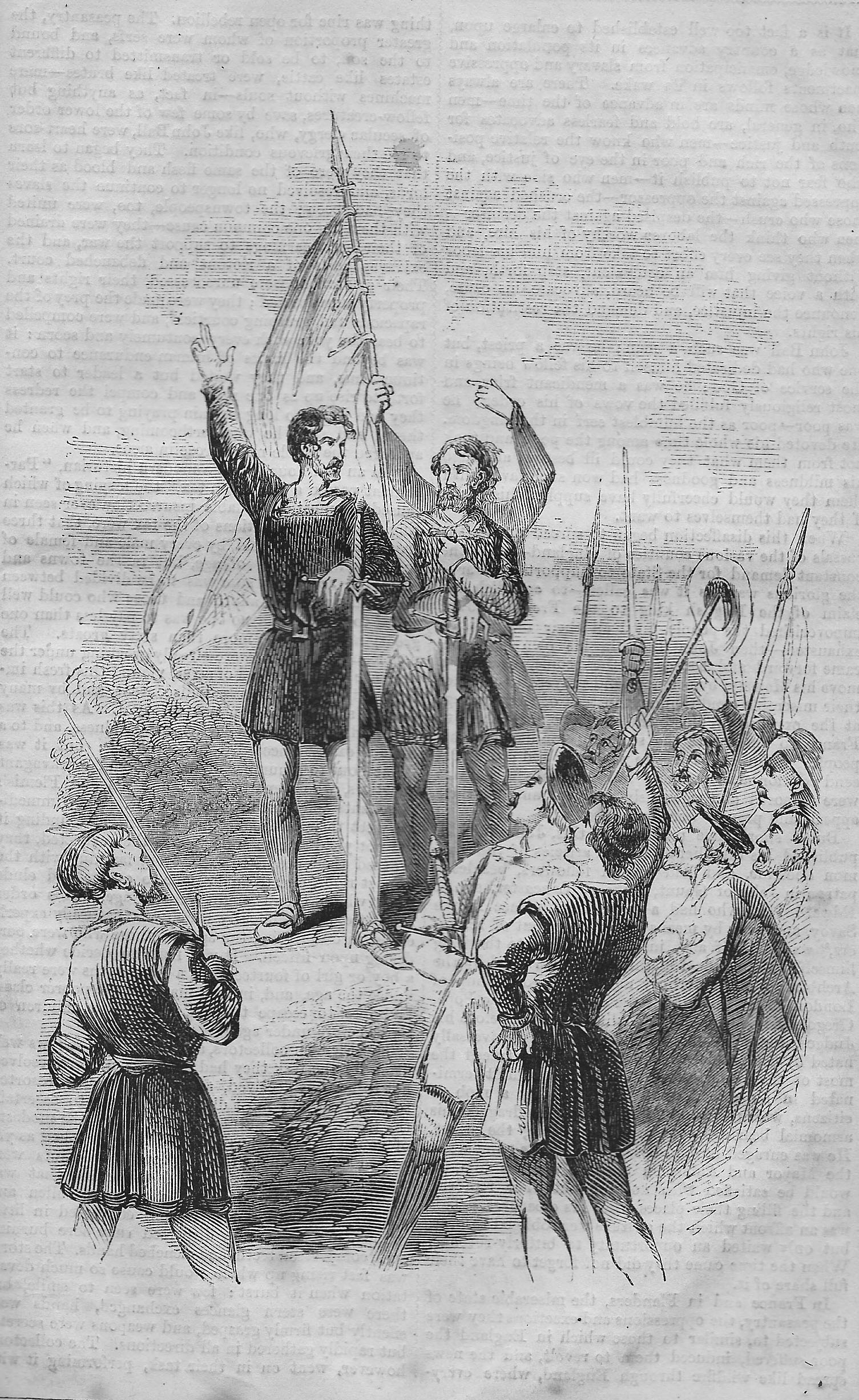
Yet several revolts were conservative in their nature. As Hilton remarks:
“although a heavy tax, or a requisition order … might not in itself precipitate a rising, it might do so in the context of strained social relationships … This strain is seen by the peasants from an apparently conservative standpoint. They cannot accept the abandonment of traditional roles by any one of the orders of society—whose basic structure they do not, to begin with, challenge.”
As we have seen, the peasants of Bagneux in the 1200s did not object to paying tallage, and they had no issue with performing their obligations to their lord, but they did object to the manner in which the tallage was levied. The peasants at Ittevile likewise were willing to take direct action to seek redress for their grievances. But they did not aim to reshape society and, so the (very limited) evidence suggests, must have been content with their station in life for neither Bagneux nor Itteville was a hotbed of insurrectionary activity in that period.
Revolts often occurred, therefore, because there was a breakdown, or perceived breakdown, in the traditional social relationship. One of the rebels’ grievances during the Transylvanian Revolt, as we have seen, was the nobles’ failure to protect the people from Turkish incursions—the Transylvanian barons, so the peasants assumed, were not living up to their obligations. The “new” tithe that the Transylvanian people were forced to pay was the straw that broke the camel’s back.
A Man’s Affair?
Many of these medieval revolts—including those not discussed here—have often been portrayed as a man’s affair. The heroes of the 1381 rebellion in England, for example, are Wat Tyler, Jack Straw, and John Ball. It was a petty nobleman who led the Transylvanian Revolt. A man led the aforementioned Jack Cade Rebellion. Women did participate in medieval revolts and Sylvia Federico has highlighted their participation in Wat Tyler’s rebellion. However, their participation in English revolts certainly does seem to have been limited. As Alexander Kaufman points out, almost all of the names of those pardoned in the aftermath of Cade’s rebellion are men’s names.

Of the examples given above women are wholly absent in the records of both the Red Turban Rebellion and the Transylvanian Revolt. In other parts of Europe there were special cases, to be sure: Joan of Arc, for instance, served as the figurehead for the campaign to rid France of the occupying English forces, although whether this war of national liberation against an occupying force can rightly be counted alongside a rebellion is open to debate. But more generally there were few women leaders and participants—there was certainly no female equivalent of Wat Tyler in England.
Of course, absence of evidence does not amount in every case to evidence of absence, as Shannon McSheffrey points out. There is the chance that when medieval chroniclers mentioned revolts, they did not think that women’s participation was worthy of notice. However, more evidence for women’s participation is present in early modern records of revolts—examined by Andy Wood—which is perhaps owing to better record-keeping by contemporary scribes as well as the fact that records from ca. 1600 are better preserved.
Revolts as a Global Phenomenon?
One final question might be raised here, although an answer cannot be forthcoming in the space permitted: what can the study of rebellions across the medieval world add to historians’ understanding of the subject? Can rebellions across the medieval world really be studied as part of a global “phenomenon” in the same manner that, say, global trade patters can? Comparative analyses of revolts in different places and periods can be useful up to a point. Such analyses allows scholars to learn about the similarities and differences between, for example, the Chinese Red Turban Rebellion and Wat Tyler’s Revolt and the Jacquerie.

Yet medieval revolts were never a truly global phenomenon. This is to say that they did not “spread” from one place to another in the manner of—to take more recent comparisons—the Revolutions of 1848 or the Arab Spring in 2010. Instead, each revolt and every rebel across the medieval world had their own peculiar causes and motives; grievances between a Transylvanian peasant and an English peasant in the fourteenth century may have been similar, but there is little evidence that peasants in either of those countries were aware of and inspired by the actions of the other. The diverse causes that led to revolts in the global medieval world perhaps mean that any history book that promises to offer a global analysis of such events could only ever realistically aspire to offering a comprehensive or comparative overview of medieval rebellions.
Further Reading:
Barker, Juliet. England, Arise: The People, the King and the Great Revolt of 1381. London: Abacus, 2014. A very useful overview of the Peasants’ Revolt which depicts the revolt, not as something that happened only in London, but as an event of national significance. Basdeo, Stephen. The Life and Legend of a Rebel Leader: Wat Tyler. Barnsley: Pen and Sword, 2018. A survey of representations of the Peasants’ Revolt throughout history with a chapter on the development of socialist views of medieval rebellions as a pan-European phenomenon. Dobson, R.B., ed. The Peasants’ Revolt of 1381. London: Macmillan, 1970. An as yet unsurpassed sourcebook on England’s most famous medieval rebellion. Federico, Sylvia. “The Imaginary Society: Women in 1381.” Journal of British Studies 40 no. 2 (2001): 159–83. Highlights the role that women played in the 1381 rebellion. Held, Joseph. “The Peasant Revolt of Bábolna 1437–1438.” Slavic Review 36 no. 1 (1977): 25–38. An article that outlines the causes of the revolt and delves into the ethnic and social backgrounds of the rebels. Hilton, Rodney. Bond Men Made Free: Medieval Peasants Movements and the English Rising of 1381. New York: Viking, 1973. A pan-European approach to the study of peasant unrest during the fourteenth century. Holmes, Catherine and Naomi Standen. “Introduction: Towards a Global Middle Ages.” Past and Present 238 no. 13 (2018): 1–44. This lengthy article is particularly good for outlining the debates on what is “global” and whether it can or should be applied to non-European people and places. McSheffrey, Shannon. “Gendering Popular Politics: Medieval Riot, State Formation, and the Absence of Women.” History Workshop Journal October 16, 2019. www.historyworkshop.org.uk/ An informative and very readable article highlighting some of the challenges that face scholars when attempting to analyse women’s participation in rebellions. Mote, Frederick W. “The Rise of the Ming Dynasty, 1330–1367.” In The Cambridge History of China, vol. 7: The Ming Dynasty, 1368–1644, edited by Frederick W. Mote and Dennis Twitchet, 11–57. 4th ed. Cambridge: Cambridge University Press, 2004. Rowe, William T. Crimson Rain: Seven Centuries of Violence in a Chinese County. Stanford University Press, 2006. A case study approach of violence and unrest in one specific area of China from the medieval to modern periods. Wood, Andy. Riot, Rebellion, and Popular Politics in Early Modern England. Basingstoke: Palgrave, 2002. An excellent overview, as the title suggests, of rebellions in the early modern period. Wood’s analyses stretch from the late medieval period to the end of the seventeenth century.
Notes
[1] Basdeo, Stephen., “Rebellion and Unrest in the Global Medieval World.” The Encyclopedia ofthe Global Middle Ages. Ed. Arc Humanities Press . London: Bloomsbury Publishing, 2019.Bloomsbury Medieval Studies Platform. Web. 19 Jan. 2024.<https://www.bloomsburymedievalstudies.com/encyclopedia-chapter?docid=b-9781350990005&tocid=b-9781350990005-903-0011421>.
Categories: 1381, China, Medievalism, Peasants' Revolt, Romania, Transylvania, Wat Tyler