
In its relatively short literary history, the United States has produced many fine novelists, though my own bias naturally draws me towards those who emerged in the early nineteenth century, when the country was still, culturally speaking, in its infancy. Among my favourites is Edgar Allan Poe, author of many macabre and unsettling tales, and a writer who still occupies a place on the shelves of modern readers with a taste for the gothic. James Fenimore Cooper, whose masterpiece The Last of the Mohicans has been adapted several times for television and cinema, likewise has a place on my shelves; I have always admired his descriptions of the unspoilt landscapes of colonial America.
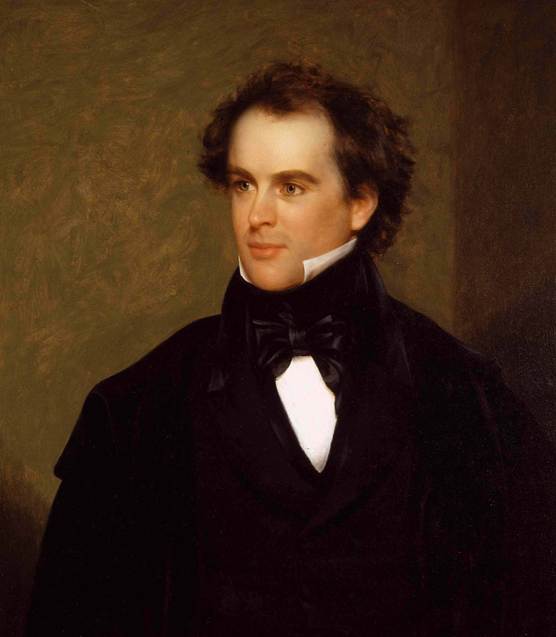
But if asked to name my favourite American novelist — indeed, one of my favourite novelists in any language — I would choose Nathaniel Hawthorne. What attracts me to Hawthorne is the seriousness of the moral questions his works raise, and the remarkable fact that they do so without ever becoming preachy. Hawthorne shows us the moral shape of an action or thought, but he seldom presumes to dictate what judgment we should make.
I had read The Scarlet Letter some time ago and have even published a piece on Feathertop in the Nathaniel Hawthorne Review some years since.[1] But other projects began to take precedence and it was only recently that I picked up in Waterstones an edition of Nathaniel Hawthorne: Young Goodman Brown and Other Tales (1998; repr. 2008). One of the short stories in this book, “My Kinsman, Major Molineux,” has made a deep impression on me because of what I perceive to be its relevance today.
The tale is rooted in Hawthorne’s own historical and imaginative setting, yet it speaks with surprising force to the modern world. Hawthorne was not a prophet in the vulgar sense of predicting future events; his gifts were deeper than that and he would never have lowered himself to becoming a Nostradamus. Rather, Hawthorne understood, with unusual clarity, certain permanent features of human nature: the desire to belong and the pleasure crowds take in humiliation.

Robin arrives in town
My Kinsman, Major Molineux is set during one of the many revolts against British authority in New England during either the late 1600s or early 1700s. While Hawthorne does not give an exact date, he does say that the story takes place
‘after the kings of Great Britain had assumed the right of appointing the colonial governors’.[2]
This would place it after 1684, from which year the English monarch began directly appointing governors for the Royal Colonies.[3] The date, however, is immaterial, for Hawthorne wishes to explore ideas, not the specificities of history.
A young man named Robin has recently arrived in the town in search of his uncle, Major Molineux, a man of wealth and social standing through whom Robin hopes to procure a professional position. Yet when he arrives and enquires of various people where his uncle might be found, he is rebuffed. People either sneer, laugh, or become hostile when his uncle’s name is mentioned. Poor young Robin cannot comprehend why people are reacting in this manner. Wandering the streets at night, he comes across an older man who tells him that he will soon see his kinsman, Major Molineux, if he waits a while.

And sure enough, he does soon see his kinsman, Major Molineux, in a cart, led by a torch-lit procession. His uncle is paraded in all his ‘tar and feathery dignity’.[4] The practice of tarring and feathering escalated in the Americas during the eighteenth century. A mob would lay hands on a victim and daub their body in wood tar or, later in the nineteenth century, syrup.[5] They would then be rolled in feathers which would stick to the victim’s body. Afterwards, in many cases, as happens to Major Molineux, a procession would be held in which onlookers were encouraged to laugh and jeer at the victim.
The processions were usually attended by large numbers of people. In Boston in 1770, over 2,000 people turned out to see a tidesman named Owen Richards get tarred and feathered.[6] It was a humiliating spectacle. The point was to publicly shame the person. In colonial America, many of those subjected to this cruelty were not criminals in any formal sense. They were often ordinary professional people who sought to fulfil the duties of their office and uphold royal authority. Hawthorne gives a harrowing description of the major in the cart:
‘He was an elderly man, of large and majestic person, and strong, square features, betokening a steady soul; but steady as it was, his enemies had found means to shake it. His face was pale as death, and far more ghastly; the broad forehead was contracted in his agony, so that his eyebrows formed one grizzled line; his eyes were red and wild, and the foam hung white upon his quivering lip. His whole frame was agitated by a quick and continual tremor, which his pride strove to quell, even in those circumstances of overwhelming humiliation’.[7]

The rituals of public shaming
Hawthorne is not interested in relitigating the rights and wrongs of British rule, nor does he make the practice of tarring and feathering itself the moral centre of his tale. Instead, Hawthorne asks us to consider why people, who had been friends and neighbours to Major Molineux, would turn on him. Hawthorne presents humans’ willingness to engage in ritual public humiliation as a disease, or ‘contagion’. Everyone is laughing at the major and ‘the contagion was spreading among the multitude’.[8]
Humans derive part of their identity through membership of social groups. Shared values, political beliefs can give us a sense of belonging. We are taught, through socialisation, not to transgress certain cultural and ideological boundaries.[9] In terms of social belonging in ‘My Kinsman, Major Molineux’, it was important for spectators to be seen shaming and mocking the victim, not only to prevent them from being ‘tarred with the same brush’ but also to feel a sense of belonging.
The desire to engage in public humiliation was a ‘contagion’. And, as the old major is being subjected to the shaming, with people ‘trampling all on an old man’s heart’, in a heartbreaking moment Robin finds himself caught up in the ‘frenzied merriment’ and begins laughing as well:
‘Then Robin seemed to hear the voices of the barbers, of the guests of the inn, and of all who had made sport of him that night. The contagion was spreading among the multitude, when all at once, it seized upon Robin, and he sent forth a shout of laughter that echoed through the street, — every man shook his sides, every man emptied his lungs, but Robin’s shout was the loudest there. The cloud-spirits peeped from their silvery islands, as the congregated mirth went roaring up the sky! The Man in the Moon heard the far bellow. “Oho,” quoth he, “the old earth is frolicsome to-night!” ’[10]
This is the most disturbing moment in the tale. Robin has spent the evening bewildered by the hostility shown towards his kinsman. He has been mocked, misled, and humiliated himself. Yet when the moment of decision comes, he does not stand apart from the crowd. He joins it. His laughter is not presented as thoughtful political conviction, nor even as deliberate cruelty. It is something more unsettling: a surrender to the emotional force of the multitude. Robin laughs because everyone else is laughing, and because laughter offers him, at last, a place within the community that had previously excluded him.
Plus ça change, plus c’est la même chose
One need not live in eighteenth-century New England to recognise the pattern. Humans act tribally.[11] Modern public life is full of rituals in which an individual is placed before the crowd and made into an object of ridicule. The instruments have changed. Tar, feathers, carts, and torches have given way to social media posts, quote-tweets, screenshots, and viral clips. Yet the psychology is recognisably similar. A crowd gathers; laughter and jeering become a badge of belonging; hesitation is interpreted as sympathy for the condemned; and the individual, like Robin, may find himself joining in not because he has reflected deeply upon the matter, but because the crowd has made non-participation feel dangerous. A general feeling of “if you’re not with us then you’re against us” prevails.
Hawthorne also leaves us asking questions about the nature of nationalist violence. Every one of Hawthorne’s American readers would have known the history of the American Revolution, the role of the Founding Fathers, and the eventual establishment of political liberty. Yet Hawthorne highlights the gap between the high-minded ideals of pre-revolutionary patriotism and their often-violent manifestation on the streets. Liberty may be a noble cause, but noble causes do not always produce noble conduct in those who claim to serve them. Unfortunately, ideological differences can also, in Robin’s case, drive a wedge between kinsmen.
The historical Molineux
There is, however, one final irony. In choosing the name of Molineux, Hawthorne was meting out a little bit of posthumous political justice. There was a merchant named William Molineux who was also a member of the Sons of Liberty (an American Revolutionary group) and who, between 1768 and 1771,
‘led nearly every mass action between 1768 and 1771 to harass the Tory publisher of the Boston Chronicle, scourge merchants who refused to abide by nonimportation agreements, or tar and feather customs informers’.[12]
The historical Molineux was associated with the Hutchinson Mob, which enthusiastically tarred and feathered those with whom it disagreed, and about which Hawthorne had also written in another tale. So, Hawthorne was well-enough acquainted with the real Molineux. While the historical Molineux had helped subject others to public terror and humiliation, in Hawthorne’s tale the victimiser became the victim.[13]
Conclusion
Nevertheless, it was only Hawthorne who could see the frail old major in the cart. Nobody else, in the New England of the eighteenth century which Hawthorne had conjured in his imagination, saw it. Hawthorne’s enduring lesson is that civilisation depends not merely upon noble causes, but upon the capacity to pity those whom the crowd has chosen to despise.
References
[1] Stephen Basdeo, ‘The First British Edition of Nathaniel Hawthorne’s “Feathertop” in Home Circle’ (1852)’, Nathaniel Hawthorne Review, 46: 2 (2020), pp. 207–12.
[2] Nathaniel Hawthorne, ‘My Kinsman, Major Molineux (1832)’, in Nathaniel Hawthorne: Young Goodman Brown and Other Tales, 2nd edn (Oxford World Classics, 2008), pp. 37–56 (p. 37).
[3] John Bach McMaster, ‘Chapter VII. How the Colonies Were Governed’, in A Brief History of the United States, https://historion.net/brief-history-united-states/chapter-vii-how-colonies-were-governed [accessed 21 June 2026].
[4] Hawthorne, ‘My Kinsman, Major Molineux (1832)’, p. 54.
[5] Benjamin H. Irvin, ‘Tar, feathers, and the enemies of American liberties, 1768–1776’, New England Quarterly, 76: 2 (2003), pp. 197–238 (p. 198).
[6] John F. Watson, Annals of Philadelphia, 2 vols. (Philadelphia: Whiting and Thomas, 1856-57), II, p. 42.
[7] Hawthorne, ‘My Kinsman, Major Molineux (1832)’, p. 55.
[8] Hawthorne, ‘My Kinsman, Major Molineux (1832)’, p. 55.
[9] R. J. Starr, ‘Public Shaming and the Psychology of Humiliation’, https://profrjstarr.com/essays/public-shaming-and-the-psychology-of-humiliation [accessed 21 June 2026].
[10] Hawthorne, ‘My Kinsman, Major Molineux (1832)’, p. 56.
[11] Cory J. Clark, et al., ‘Tribalism Is Human Nature’, Current Directions in Psychological Science, 28: 6 (2019), https://doi.org/10.1177/0963721419862289
[12] Gary B. Nash, The Unknown American Revolution: The Unruly Birth of Democracy and the Struggle to Create America (New York: Viking, 2005), p. 97.
[13] Maria Trninc, ‘Blackening Character, Imagining Race, and Mapping Morality: Tarring and Feathering in Nineteenth-Century American Literature’ (Ph.D. dissertation, Texas A&M University, 2013), p. 120.
Categories: 19th Century, Nathaniel Hawthorne, novels